

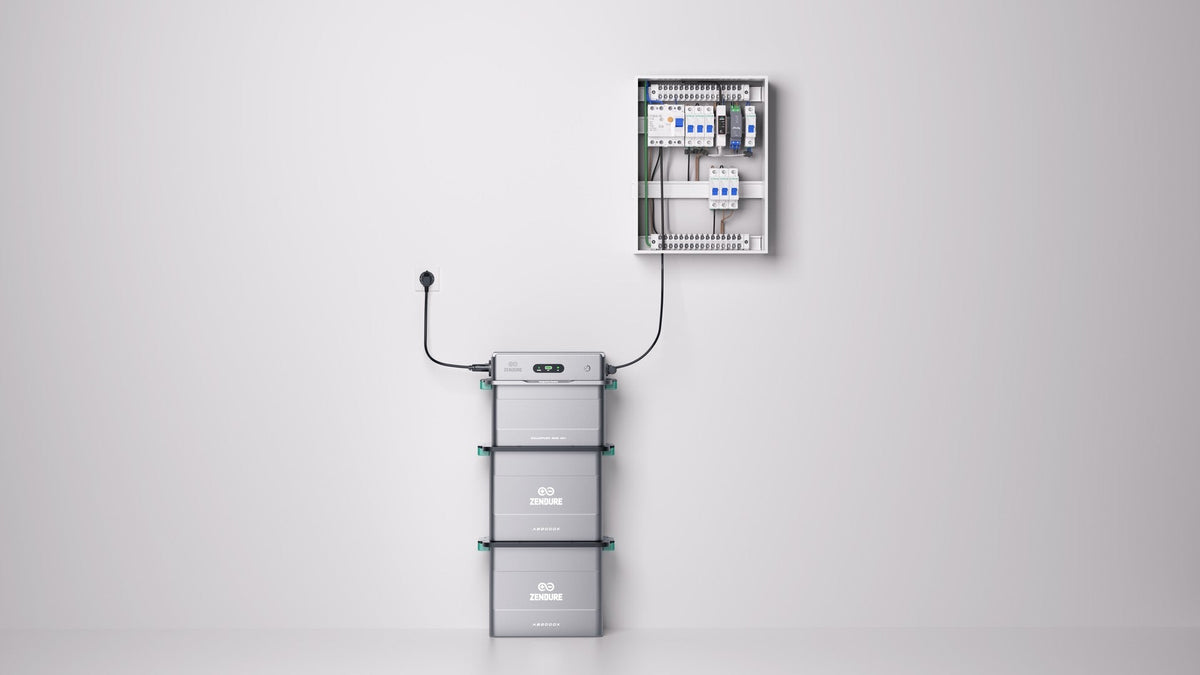
Single-phase or three-phase home battery: which one fits your meter cabinet?
For your fuse box, a single-phase home battery fits on any connection, while a three-phase home battery only works if your fuse box has three phases. For most households a single phase is plenty, even if there's three-phase power in the fuse box. Three phases only become interesting when you draw a lot of power at once or want to keep your entire home running on backup power.
In this blog you'll read how to recognize your connection, what happens when the battery and your consumption are on different phases, and how plug-in systems still let you use all three phases.
What's the difference between a single-phase and a three-phase home battery?
The difference between a single-phase and a three-phase home battery lies in the number of wires the battery uses to charge and deliver power. A single-phase battery uses one phase of your home's wiring, while a three-phase battery spreads charging and discharging across all three phases at once. The storage capacity in kWh is separate from this: the difference is in the power, the connection you need, and what keeps working during a power outage.
Every home battery for your house falls into one of these two groups. A single-phase home battery is easier to install, but its power is limited by the one phase it shares with the rest of the house. A three-phase home battery delivers more power, but it requires a fuse box with three phases, a heavier inverter and always an installer. Your connection is therefore the first filter: start with your own fuse box and only then look at the power you actually need.
How can you tell whether you have a single-phase or three-phase connection?
You can tell whether you have a single-phase or three-phase connection by looking at three parts in your fuse box. You don't need to unscrew or disconnect anything, because everything is right there on the outside of the components. Do check it before you choose a home battery, because your connection determines which systems are an option for you. Pay attention to these three points:
- Main switch: a 2-pole main switch belongs to a single phase, while a 4-pole one goes with three phases.
- Main fuse: a label like 1x25A or 1x35A means one phase, 3x25A means three phases.
- Smart meter: if the display or the rating plate shows only L1, you have one phase; if it shows L1, L2 and L3 or 3x230/400V, you have three phases.
If you're still unsure, you can also find your address's connection value at your grid operator. Never work behind the main switch yourself, as that part of the meter cupboard is for a certified installer.
Can a 1-phase home battery work on a 3-phase connection?
Yes, a 1-phase home battery can work on a 3-phase connection. The battery is then connected to one of the three phases and supplies its power to your home installation through that phase. This is the usual situation with home batteries that you connect yourself, since the Zendure and Anker SOLIX home batteries at TechPunt are all 1-phase systems.
That this works well comes down to two things: the way your smart meter settles the phases and the meter the battery uses to keep an eye on all phases.
The smart meter settles all phases together
The smart meter settles all phases together, so you don't lose any power if the home battery is on a different phase than your consumption. A Dutch smart meter adds the three phases together and only records the balance of your entire connection.
If the battery supplies 800 watts on phase 1 while the washing machine draws 800 watts on phase 2, the meter records nothing on balance. That's why the display doesn't show counters per phase either, but four registers: supply and feed-in, each at a high and a low rate.
A P1 meter or CT clamps measure all three phases
A P1 meter or CT clamps measure all three phases, so the battery knows how much power your home is drawing at that moment. A P1 meter reads out the smart meter and passes on the total of all phases, and for charging and discharging on the balance that's enough.
CT clamps go around the phase wires in the fuse box and measure each phase separately. For that you have the Zendure Smart Meter 3CT with three clamps and the Anker SOLIX Smart Meter Gen 2 in the three-phase version with the Triple CT cable assembly.
You'll find both meters among the accessories for your home battery. The meters are brand-specific, so choose the meter from the same brand as your battery. CT clamps are installed in the meter cabinet, so leave that to an installer.
Why does a home battery with a plug always work on a single phase?
A home battery with a plug always works on a single phase, because every socket is on one circuit and every circuit is on one phase. A plug-in home battery that you plug in yourself is therefore always a 1-phase system, even in a home with three phases. The power then depends on the circuit: a standard 16 amp circuit can handle around 3,680 watts, and you share that capacity with everything else connected to that circuit.
If you want to get more power out of a single unit, an electrician can connect the battery to its own circuit. That delivers up to 3,500 watts with the Anker SOLIX Solarbank Max AC and up to 4,000 watts with the Zendure SolarFlow 4000 Mix series. Even then, it remains a 1-phase system. You can read how to go about this in the blog on connecting a home battery.
When do you need a 3-phase home battery?
You need a 3-phase home battery in two situations: when a single phase doesn't provide enough power for what your home demands at the same time, or when you want to keep the entire home running during a power outage. For storing solar power for the evening, a single phase is more than enough for most households.
When a lot of power is being drawn at once by a heat pump, charging station or induction hob
When a lot of power is being drawn at once by a heat pump, charging station or induction hob, you'll need a 3-phase home battery, because a single phase becomes too tight. A 1x25 amp connection delivers around 5.7 kilowatts in total, and 1x35 amp around 8 kilowatts. A 3x25 amp connection comes to more than 17 kilowatts, spread across three phases.
If those devices are running at the same time, you'll quickly hit the limit on a single phase, especially if the battery is charging on that same phase. The same goes for a dynamic energy contract: the more power the battery has, the more electricity it can store during the cheapest hours.
For backup power for the entire home
For backup power for the whole home on a 3-phase connection you need a 3-phase system, because only a system that feeds all three phases keeps the entire meter cabinet running. During a power outage, a battery only supplies power to whatever is physically connected to its backup power supply. A single 1-phase battery on three phases then powers at most the devices on its own backup output.
On a 1-phase connection it's different. There, a single battery with an automatic switch can take over the whole house, like the Anker SOLIX Solarbank Max AC with the Backup Auto-Switch. That switch is only suitable for homes with a single phase. You can see which models have a backup power function at the home batteries with backup power.
How do you build up a 3-phase home battery with plug-in systems?
You build up a 3-phase home battery with plug-in systems by distributing multiple 1-phase units across the three phases. There are two routes for this:
- Separate units per phase: you place two or three batteries of the same brand on different phases and have them controlled by a meter that sees all phases, provided the system supports multiple units.
- Zendure PowerHub 3P: this central hub links three SolarFlow Mix units, one per phase, into a single system of up to 12 kilowatt continuous and keeps all three phases running during a power outage.
Both setups call for an installer, because work is done in the meter cabinet and the load across the phases has to stay balanced. A home battery from 0.8 kilowatt also needs to be registered with your grid operator. You can read what's involved in the blog about registering a home battery.
Choose a home battery that matches your connection
If you have a single phase, you choose a 1-phase home battery and you're all set. If you have three phases, you usually also start with one unit and a meter that sees all phases. Later you expand to multiple units or a PowerHub 3P, as soon as you need more power or full backup power.
At TechPunt you'll find Zendure and Anker SOLIX with the matching meters, shipped from our own warehouse in Barneveld. Not sure about your meter cabinet? Just ask your question by phone, email or WhatsApp.


