

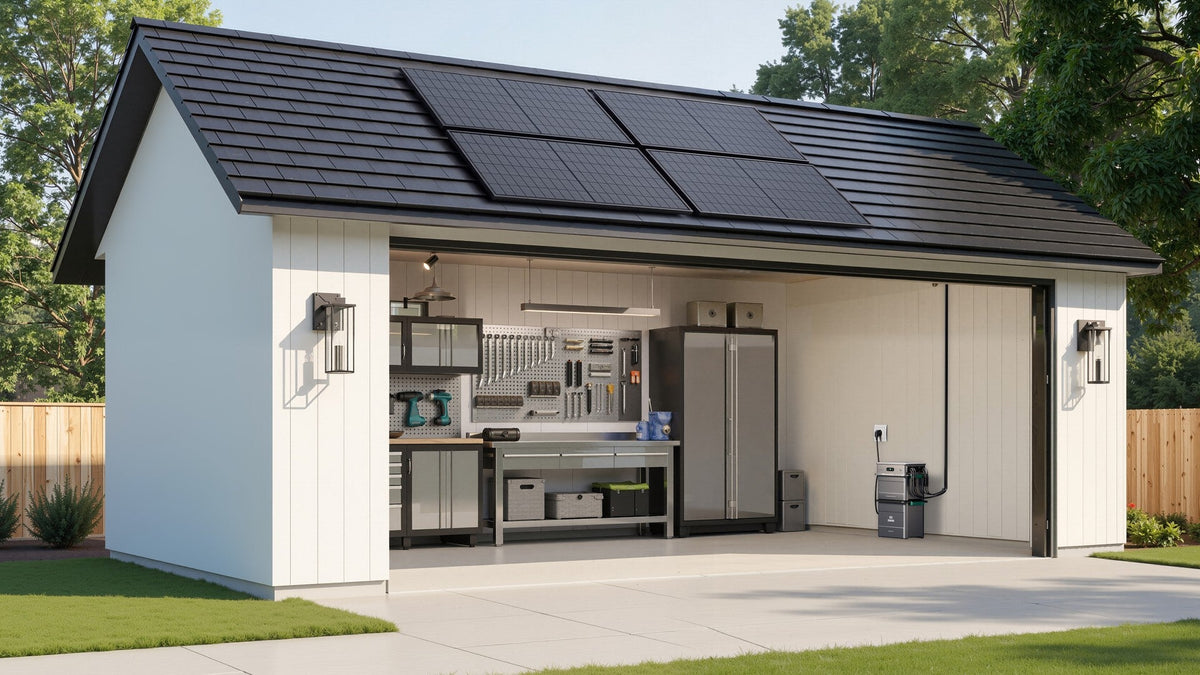
Where to place a home battery: the best spot in and around your house
You install a home battery in a dry, cool and ventilated space outside your living space and outside your escape route, such as a shed, garage or utility room. The fire brigade calls the shed the most fire-safe spot, with the garage and the attic as alternatives. Below you can read, per space, what works, what you're better off avoiding and what a battery needs.
Where is the best place to install a home battery?
It's best to install a home battery in a separate space that is dry, cool and well ventilated and that can be reached from the outside. Which space suits you also depends on the model, because home batteries vary quite a bit in weight, housing and the way they're connected.
The Netherlands Institute for Public Safety (NIPV) advises against placing a home battery in living and residential areas, and instead recommends a space that emergency services can reach from the outside.
In most homes that leaves you with four spots: the shed, the garage, the utility room and the attic. A battery of just over 20 kilos is easier to get into the attic than a complete unit of around 80 kilos.
Where can you install a home battery according to the fire brigade?
According to the fire brigade, you may install a home battery in a cool, ventilated spot outside your escape route, on or against a non-combustible surface. The fire brigade has separate advice for fixed home batteries and for plug-in batteries, but the requirements for the spot largely overlap:
- Escape route: don't place the battery in the hallway, on the landing or under the stairs, so smoke won't block your way out.
- Detector: hang a working smoke detector in the same space; for a battery the fire brigade also recommends a CO detector.
- Surface: mount the battery on or against a non-combustible surface, such as a brick wall or a non-combustible base plate.
- Clear space: keep the area around it clear, don't put anything on top of the battery and don't place it under furniture, near the heating or in direct sunlight.
- Accessibility: choose a spot that you and the emergency services can reach easily.
- Stability: avoid spots where the battery can get wet, tip over or where you'll quickly bump into it.
These requirements apply to every space covered below. If a spot fails on even one point, like a battery under the stairs, then look for another space, even if there's plenty of room.
Installing a home battery per space in and around your home
Installing a home battery is different in each space, because temperature, accessibility and the distance to your living space all vary. Below you'll find the spaces that work in most homes and the spaces you're better off skipping. The attic gets its own explanation further down.
Installing a home battery in the shed
According to the fire department, installing a home battery in the shed is the most fire-safe choice. A shed stands separate from your home, is often cool and well ventilated, and the fire department can reach it directly from outside.
Do have an installer assess whether the power cable to the shed can handle the battery's capacity. A detached shed is usually unheated, so choose a model that can handle the winter temperature and mount a smoke detector there.
Installing a home battery in the garage
Installing a home battery in the garage is a good alternative if you don't have a shed. A garage isn't an occupied space and often has its own door to the outside. Place the battery somewhere you won't bump into it with your car or bike.
In an unheated garage, the winter temperature matters: according to the manufacturer, the Zendure SolarFlow Mix models and the Anker SOLIX Solarbank Max AC work down to -20 °C, but a Zendure battery only charges above 0 °C and first warms itself up with power in freezing conditions.
Installing a home battery in the utility room
Installing a home battery in the utility room or storage room is possible, as long as that space isn't your escape route. A utility room doesn't count as a living or occupied space and often has its own exterior door, which fits the NIPV advice for a space that's accessible from outside.
If your only exit runs through the utility room, or the outlet is on the same circuit as the washing machine, then choose a different spot or a different outlet.
Can a home battery go in the meter cupboard?
No, a home battery doesn't belong in the meter cupboard, because most meter cupboards are too small and located near the front door. That spot therefore falls within your escape route, and the fire department advises against a battery there.
The meter cupboard does play a role: that's where the circuit the battery is connected to sits, and according to the fire department that's where you mark that there's a home battery in the house, along with the supplier's number.
Why not put a home battery in the basement?
Installing a home battery in the basement is not recommended, because according to the NIPV, in the event of a defect flammable gases can actually build up in an enclosed space like a basement.
A basement is also hard to reach for emergency services and often damp. That makes the basement unsuitable, even if the temperature stays stable there all year round. The same consideration applies to a crawl space.
Why not put a home battery in the living room?
A home battery in the living room or bedroom doesn't fit the advice from the NIPV, which rules out living and occupied spaces.
Those are the spaces where you spend most of your time, including when you sleep, and a battery in a separate space gives you distance and time. The fire department also opts for a separate space like a shed or garage, rather than the place where you sit every day.
Can you install a home battery in the attic?
Yes, you can place a home battery in the attic, as long as you take heat, weight and accessibility into account. The fire department mentions the attic as an alternative for a fixed home battery if you don't have a shed or garage.
For a home battery with a plug, the fire department prefers the ground floor, because the battery is more accessible there.
Heat is the first thing to consider. An attic under the roof heats up considerably in summer, while most models at TechPunt work up to 55 °C according to the manufacturers. An insulated and ventilated attic keeps the temperature more stable than an attic without insulation.
Weight is the second point. A Zendure SolarFlow Mix unit weighs around 80 kilos and an Anker SOLIX Solarbank Max AC 63 kilos, even without extra batteries.
That unit has to go up the stairs and the attic floor has to carry the weight. A modular set, like the Zendure SolarFlow 800 Plus at just over 21 kilos with separate expansion batteries, you build up module by module in the attic.
Finally, don't put the battery near the attic stairs, because those stairs are your escape route downstairs, and here too hang a smoke detector in the same room.
Place a home battery indoors or outdoors?
In principle you place a home battery indoors or in an enclosed outbuilding such as a shed or garage. There the battery stays dry, out of direct sunlight and at a more stable temperature, and those are exactly the points the fire department mentions for the location.
Placing it outside is only possible with a model the manufacturer approves for that. Zendure and Anker SOLIX describe their models with an IP65 or IP66 enclosure as suitable for indoors and for a sheltered spot outside, so even then you choose a spot out of the rain and direct sunlight. You can read what to watch out for with an outdoor setup in our guide on placing a home battery outside.
Where do you place a home battery with a plug?
According to the fire department, a home battery with a plug is best placed on the ground floor, in a room with a stable room temperature and close to a free, grounded outlet.
So with a plug and play home battery, the outlet partly determines where it goes, because the fire department advises against an extension cord or power strip. Also check the circuit in the meter cupboard that the outlet is connected to.
The fire department recommends a maximum of one home battery per circuit and no circuit shared with heavy appliances like the washing machine; a separate circuit is preferred. If the only suitable outlet is on a full circuit, choose a different spot or have an installer set up a separate circuit.
How far can a home battery be from the meter cupboard?
A home battery may sit some distance from the meter cupboard, as long as the power cable and the data signal can bridge that distance. In practice, the cable length of your model and the range of your wifi determine how far you can go.
For the power, Anker SOLIX gives you the choice of AC cables of 5 and 15 metres with a Wieland plug and a 15-metre cable with a Schuko plug, so the Solarbank also fits an earthed socket that's further away.
A fixed connection on a dedicated circuit goes through an installer, who also assesses whether the cable to a shed or garage can handle the power. You'll find what you need for your setup in the home battery accessories.
For the control, the signal matters. A P1 meter on your smart meter, like the Zendure Smart Meter P1, sends your consumption data wirelessly, so the battery knows when to charge or discharge. That's why you should check at your chosen spot whether your wifi is strong enough.
Checklist for placing your home battery
With this checklist for placing your home battery, you can check in just a few minutes whether a spot is suitable:
- Room: a shed, garage, utility room or insulated attic, not a living room, bedroom, cellar or crawl space.
- Escape route: not in the hallway, by the front door, on the landing or under the stairs.
- Surface: firm, level and non-flammable, and strong enough for the weight of the complete set.
- Climate: dry, ventilated, out of direct sunlight and within the manufacturer's temperature range.
- Detector: a working smoke detector in the same room.
- Power: an earthed socket without an extension cord, on a circuit without heavy appliances.
- Signal: enough wifi coverage for the app and the P1 meter.
- Notification: a note in the meter cupboard and a heads-up to your insurer.
If every point checks out, you've found a suitable spot for your home battery. If a spot fails on one point, go back through the spaces above once more before choosing an alternative.
Which model suits the spot for your home battery?
Which model is right depends on where you place your home battery, because every space has different requirements. An unheated garage or shed calls for a battery that can handle frost, an attic for a lightweight modular set that you carry up module by module, and a spot far from the meter cupboard for a long connection cable and good wifi coverage.
At TechPunt you can compare all home batteries from Zendure and Anker SOLIX side by side, with an IP65 or IP66 housing, expansion batteries that you build up module by module, and connection cables up to 15 metres. Once you've chosen your model, we'll ship it from our own warehouse in Barneveld.


